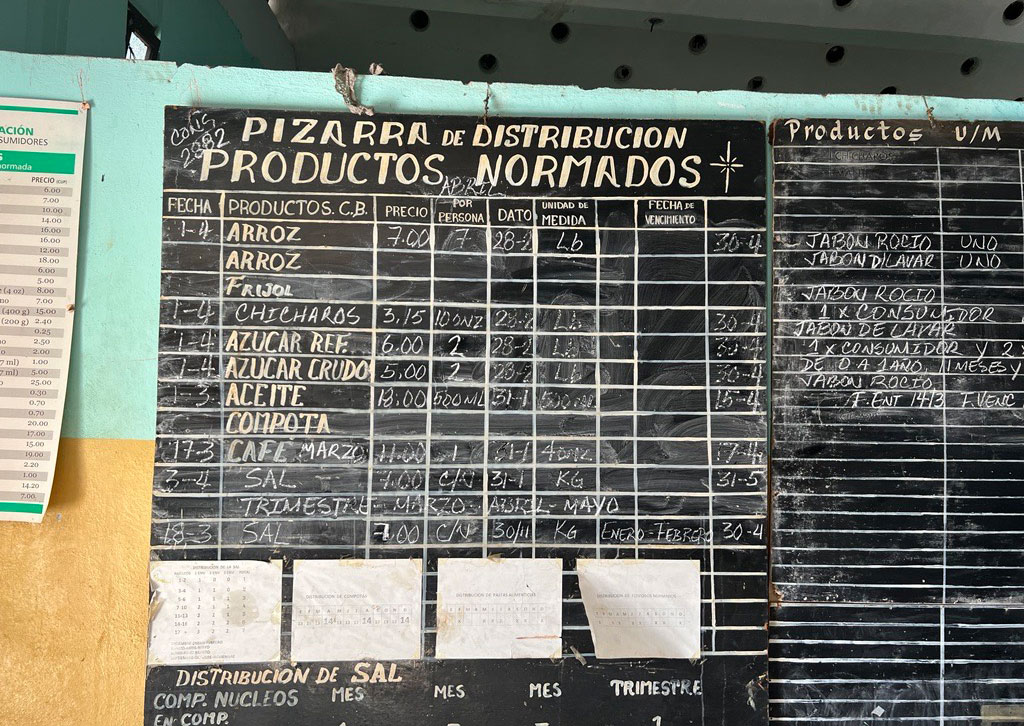
 The grocery list at a government-run store in Havana
Apr 12, 2023
HAVANA, CUBA – Last week, USA Rice Vice President of Policy & Government Affairs Peter Bachmann participated in the U.S.-Cuba Agriculture Business Conference organized by the U.S. Agriculture Coalition for Cuba with the hope of furthering engagement between U.S. rice exporters and the Cuban private sector.
Throughout the conference, the delegation met with Cuban importers, including Alimport, the Cuban government’s primary buying agency, and with members of the emerging private sector and cooperatives, some that are quasi-government and others that are privately operated.
In the second term of the Obama Administration, the U.S. took a more liberalized approach to engagement with Cuba, making travel, investment, and trade easier for Americans. However, a series of legislative restrictions preventing U.S. financing of exports to Cuba and the actual embargo itself have not been addressed since the early 2000s. The Trump Administration rolled back nearly every U.S.-Cuba regulatory change and added Cuba to the state-sponsored terrorism list. The Biden Administration has made no significant changes in policy towards Cuba.
“What many people don’t know is that despite the embargo being in place, there are regulatory pathways that allow for U.S. exports to Cuba so long as buyers make the full payment upfront without any U.S. financing,” said Bachmann.
This business strategy led to $295 million in U.S. poultry exports to Cuba in 2022.
“Right now, Cuba buys most of its rice from Vietnam with a little bit coming out of South America. With competitive pricing and given our logistical advantage, there is a possibility that limited, targeted sales from the U.S. could occur in the foreseeable future as a way to slowly get back into the market,” said Bachmann.
As a developing country, it is difficult for Cubans to prioritize using their limited cash on U.S. rice when they’re able to get 12 or 18-month credit terms from Vietnamese exporters. However, the rice they buy from Vietnam takes months to arrive by boat and is often lower quality with as much as 15-20 percent brokens. U.S. exporters could provide milled rice, or even paddy rice for further processing in Cuba, in a matter of hours out of the Gulf of Mexico.
Bachmann concluded, “while we understand it is a politically sensitive subject for both parties in Congress, USA Rice will continue to advocate for further U.S.-Cuba engagement to expand export opportunities for U.S. rice.”
Prior to the embargo, Cuba was the largest export market for U.S. rice.