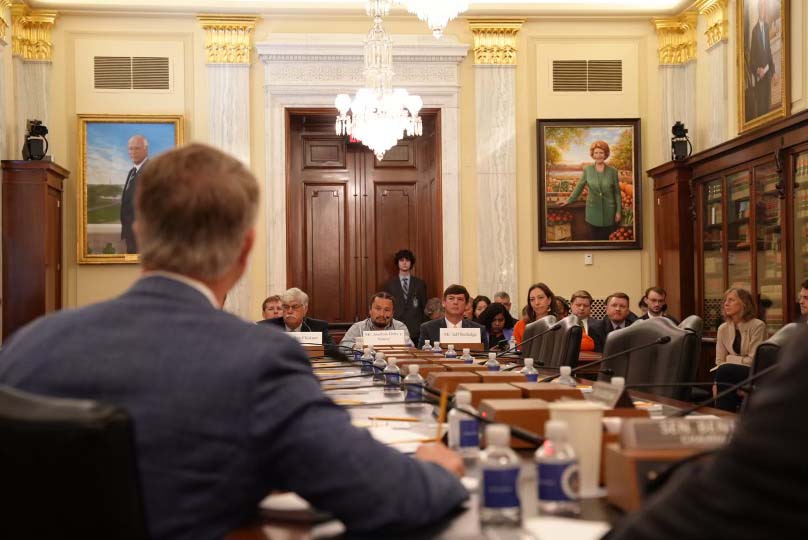
 Arkansas rice farmer Jeff Rutledge (center) takes the long view at today's Senate Ag hearing
Apr 20, 2023
WASHINGTON, DC – This morning, Arkansas rice farmer Jeff Rutledge testified during a hearing on Farm Bill conservation programs before the Senate Agriculture, Nutrition, and Forestry Committee’s Subcommittee on Conservation, Climate, Forestry, and Natural Resources.
Rutledge’s testimony focused on the importance of key voluntary conservation programs that are authorized by the Farm Bill and utilized by rice farmers, as well as 2023 Farm Bill conservation priorities that have been identified by the USA Rice Farmers Board of Directors, the leading national organization representing rice farmers in all rice producing states.
“As a farmer, I’m proud to live, sustainably manage, and earn my living from land at the nexus of production agriculture and conservation,” Rutledge told subcommittee members. “In addition to rice and the other crops I produce, we are proud to provide critical habitat to hundreds of species of wildlife, particularly migratory waterfowl, namely ducks.”
Rutledge spoke about the importance of prioritizing working lands conservation programs, such as the Environmental Quality Incentives Program (EQIP) and the Conservation Stewardship Program (CSP), as Congress deliberates the 2023 Farm Bill. He reminded members that “working lands programs like EQIP and CSP serve as economic drivers.”
Rutledge also highlighted that Farm Bill conservation programs should remain voluntary, incentive-based, and locally-led, which has offered great success for rice farmers getting conservation on the ground on their farms.
“Because rice is a unique cropping system and a 100 percent irrigated crop, conservation programs should not provide one-size-fits-all solutions,” he said. “For instance, focusing solely on a practice like cover cropping that most rice farmers cannot utilize would be inequitable for rice farmers. That’s why solutions should be locally led and support local priorities.”
Rutledge pointed to the Regional Conservation Partnership Program, the USA Rice-Ducks Unlimited Rice Stewardship Partnership, celebrating its 10th year of delivering rice-specific conservation results.
“The Rice Stewardship Partnership’s RCPP projects have pulled together nearly one hundred diverse partners and has had phenomenal success in delivering on the ground conservation to rice farmers. Since the creation of RCPP in the 2014 Farm Bill, the RSP has impacted more than 800,000 acres of rice and rice rotation ground and provided more than $108 million in additional conservation funding…Congress should work to address administrative barriers for partners through thoughtful and minimal solutions.”
Rutledge concluded by speaking to the need for a strong farm safety net for rice farmers to ensure those farmers remain economically viable so they can deliver conservation results.
“Rice farmers are passionate conservationists. They invest their own financial resources to bring these Farm Bill conservation programs to their farm. However, none of these historic producer investments in conservation can happen if the farm is not profitable,” he said. “I urge Congress to ensure all producers have the safety-net to continue to be sustainable both economically as well as environmentally.”
When Subcommittee Chair Senator Michael Bennet (D-CO) asked each witness for the one Farm Bill “need to have,” Rutledge responded, “A farm safety net that works is the most critical to keep farmers in business so they can continue to be good stewards of the land and leave a lasting legacy for the next generation of farmers.”